
How to Teach Columbus Day and Indigenous Peoples’ Day in Upper Elementary

For upper elementary teachers, teaching Columbus Day and Indigenous Peoples’ Day can be challenging, especially when students come to class with different ideas about these important and often complex topics.
October often brings these topics into the classroom, but they are not always easy to teach. Students may already have heard different versions of the story of Christopher Columbus, while others may have little background knowledge about Indigenous peoples and their experiences.
This can leave teachers wondering how to teach the history accurately while helping students understand that historical events can affect different groups of people in very different ways.
The goal is not to avoid the difficult parts of history or reduce the topic to a single perspective. Instead, these lessons can give students opportunities to learn about the past, consider different perspectives, ask questions, and use evidence to develop a more complete understanding.
Start With What Students Already Know
Before introducing new information, find out what students already believe about Columbus and Indigenous peoples.
Ask questions such as:
Who was Christopher Columbus?
What do you already know about his voyages?
Who was living in the Americas before Europeans arrived?
What might different people have thought about these events?
This gives you a starting point and can reveal misconceptions that need to be addressed.
For example, the Smithsonian's National Museum of the American Indian notes that Indigenous peoples had populated the Western Hemisphere for thousands of years before Columbus arrived. It also recommends including Indigenous perspectives, including those of the Taíno, when teaching about Columbus.
Teach the History Without Reducing It to One Story
A Columbus lesson does not have to focus only on the voyage itself.
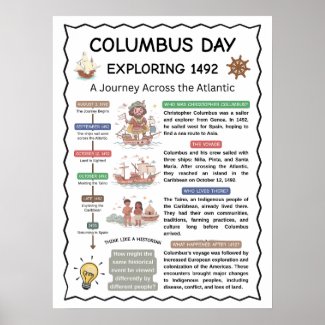
Students can learn about Columbus, his 1492 voyage, European exploration, and the people who were already living in the Caribbean.
This gives students a broader historical context.
Rather than simply asking students to memorize what happened, encourage them to consider questions such as:
What happened?
Who was involved?
What did different people experience?
How did these events affect people?
These questions encourage students to think historically rather than simply memorize facts.
Include Indigenous Perspectives
One of the most important adjustments teachers can make is to avoid presenting Indigenous peoples only as people from the past.
There is no single Indigenous culture or experience. Indigenous nations have distinct histories, cultures, languages, and traditions, and Indigenous peoples continue to live and contribute to communities today.
When teaching about the Columbus era, students can learn about the Taíno and the impact of European contact on Indigenous communities.
They can also explore Indigenous cultures and contemporary perspectives beyond the Columbus topic.
This helps students understand that Indigenous history is not simply a chapter that ended after European contact.
Help Students Compare Perspectives
Upper elementary students are capable of considering more than one perspective when the discussion is appropriately structured.
For example, students might examine how Columbus and Indigenous peoples could have experienced the arrival of Europeans differently.
You might ask:
How might Columbus have described the voyage?
How might Indigenous people have experienced the arrival of Europeans?
Why might two groups describe the same event differently?
The goal is not to tell students what conclusion to reach.
The goal is to help them understand that historical events can affect different groups in different ways.
Use Reading and Writing to Slow Down the Conversation
These topics can generate strong reactions, especially when students already have ideas about Columbus or Indigenous Peoples’ Day.
Reading passages give students an opportunity to build background knowledge before discussing the topic.
Writing can then help them process what they learned.
For example, students could respond to prompts such as:
What is one new thing you learned?
How did learning another perspective change or expand your understanding?
What questions do you still have?
If you want a ready-to-use way to combine reading, writing, and activities around the Columbus topic, a resource such as Columbus Day Reading Comprehension - Writing - Word Searches and Coloring Pages can give students multiple ways to engage with the topic.

Make Indigenous Peoples’ Day More Than a Columbus Day Alternative
Indigenous Peoples’ Day can be an opportunity to learn about Indigenous peoples, histories, cultures, sovereignty, and contemporary life rather than treating the day simply as a replacement name for Columbus Day.
The National Council for the Social Studies highlights the importance of incorporating meaningful perspectives on Indigenous peoples and nations into social studies education.
Teachers can use the day to explore Indigenous cultures and communities while helping students understand that Indigenous peoples are diverse.
A resource such as Indigenous Peoples' Day Activities Reading Passages Coloring Pages Word Searches can provide a practical starting point when teachers need ready-to-use reading and activity options.

Keep the Focus on Learning, Not Just the Holiday
It can be tempting to make these October lessons primarily about crafts, coloring, or holiday activities.
Those activities can have a place in the classroom, but they become more meaningful when connected to content.
A coloring page, for example, can reinforce information students have already learned. A word search can provide vocabulary review. A writing activity can give students an opportunity to process a historical perspective.
The activity should support the learning goal rather than replace it.
Final Thoughts
Teaching Columbus Day and Indigenous Peoples’ Day in upper elementary requires thoughtful planning because the history involves different experiences and perspectives.
Students can learn about Columbus and European exploration while also learning about the Indigenous peoples who were already living in the Americas and the effects of European contact.
By using multiple perspectives, age-appropriate sources, reading, discussion, and writing, teachers can help students move beyond a simple “heroes and villains” version of history.
The goal is not to make a complicated history simple.
It is to help students understand it more completely.

Meryma Learning
Hello, I'm Meryem, a passionate teacher crafting resources to make teaching a breeze. Join me on a journey of creativity and support for fellow educators!


